


Bored Pier Drilling Melbourne: The Engineer’s Guide to Foundation Piling (2026)
- jag mangat
- Mar 10
- 13 min read
On a recent project in Kew, an unexpected basalt shelf discovered 4 metres down added over A$120,000 and two weeks to the foundation piling schedule. It’s a costly scenario that plays out across Melbourne’s eastern and western suburbs with alarming regularity. We know you can't afford that kind of uncertainty. The pressure to deliver a structurally sound foundation on time and within budget is immense, especially when council approvals and engineering certifications are on the line.
This guide is built to eliminate those variables. Here, you will master the technical, geological, and regulatory complexities of bored pier drilling Melbourne, giving you the clarity to select the right piling method, accurately forecast costs, and ensure your project’s structural integrity from day one. We'll break down everything from navigating Melbourne's challenging ground conditions to comparing CFA and bored piling systems and streamlining the certification process for a seamless project delivery.
Key Takeaways
Understand how to assess Melbourne's unique geological challenges, from reactive clays to basalt, to correctly specify your project's foundation system.
Evaluate the critical differences between bored piers, CFA, and screw piles based on load capacity, site suitability, and cost to make the optimal engineering choice.
Gain a clear overview of the end-to-end process for professional bored pier drilling melbourne, including the specialised tooling required for hard rock excavation.
Discover how an engineering-led Design & Construct (D&C) model streamlines project delivery and guarantees structural integrity from the initial design phase.
Table of Contents Understanding Bored Pier Drilling in the Melbourne Landscape The Technical Process: How Professional Bored Piles are Drilled and Poured Bored Piers vs. Alternative Piling: Selecting the Right Foundation Navigating Melbourne’s Rock: Challenges in Bored Pier Construction Partnering with Buildco Group: Engineering-Led Piling Solutions
Understanding Bored Pier Drilling in the Melbourne Landscape
A building’s strength is determined by its foundation. In Melbourne’s complex geological environment, standard shallow footings often don’t provide the necessary long-term stability. This is where bored piers come in. Bored piers are high-capacity, deep foundation elements, engineered by drilling cylindrical shafts deep into the ground, reinforcing them with steel cages, and filling them with high-strength concrete. They are cast directly on-site, creating a solid, monolithic support structure tailored to the specific ground conditions of your project.
The primary function of a bored pier is to transfer immense structural loads through weak or reactive upper soil layers to a stable, load-bearing stratum of rock or dense soil far below the surface. This process aligns with core deep foundation principles, ensuring the building's weight is anchored securely. For projects requiring robust support against both vertical (gravity) and lateral (wind and soil pressure) forces, the bespoke nature of bored pier drilling in Melbourne provides an unparalleled engineering solution. Key benefits include:
Minimal Vibration: The rotary drilling process is quiet and produces minimal ground vibration, making it ideal for construction in dense urban areas and near existing structures.
High Load-Bearing Capacity: Bored piers can be designed to support exceptionally heavy loads, making them essential for multi-story residential and commercial buildings.
Depth and Diameter Flexibility: We can adjust the pier’s depth and diameter to precisely match the engineering requirements and ground conditions revealed by a geotechnical report.
Melbourne's Geology: Newer Volcanics and Silurian Siltstone
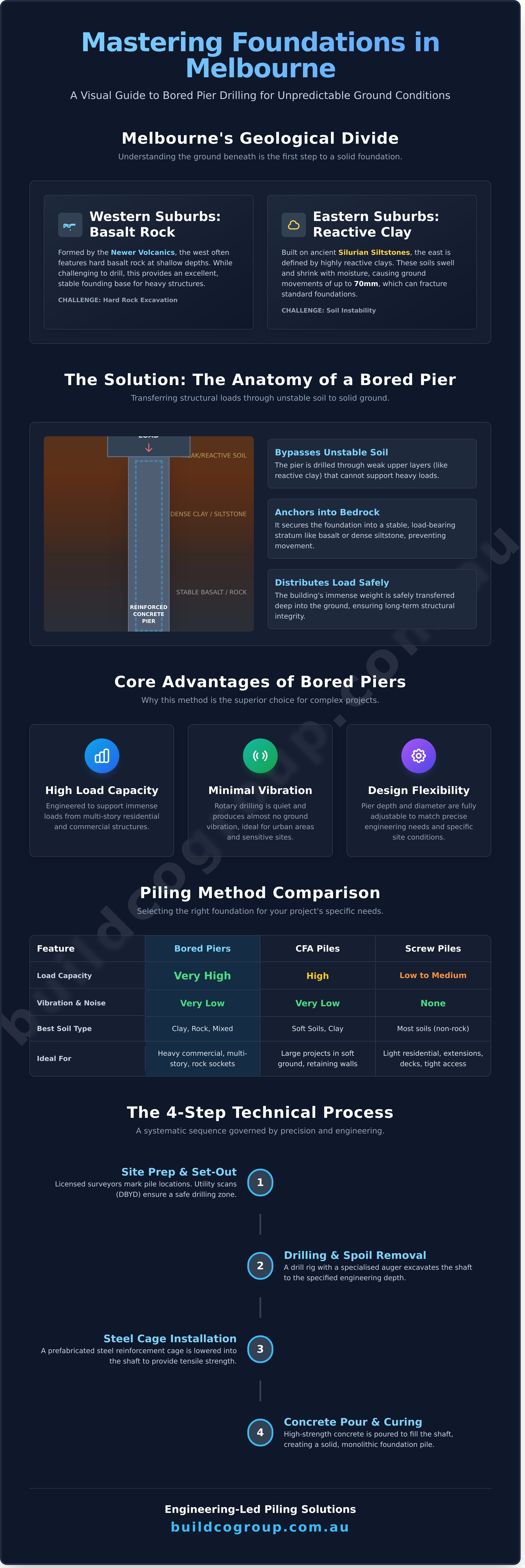
Melbourne’s landscape is a tale of two geologies. To the west, vast basalt plains formed by the Newer Volcanics mean contractors often encounter hard rock at shallow depths. While challenging to drill, this basalt provides an excellent founding base. In contrast, Melbourne's eastern and southeastern suburbs are built upon much older Silurian siltstones and mudstones. Over millions of years, these have weathered into the highly reactive clays that define the region. These clays swell significantly with moisture and shrink as they dry, causing seasonal ground movements of up to 70mm, which can easily compromise or fracture inadequate foundations.
When to Choose Bored Piers Over Standard Footings
A site-specific geotechnical investigation is the only way to definitively determine foundation requirements. However, bored piers are generally the superior choice when a project involves significant structural loads or challenging site conditions. Standard footings simply can't offer the same level of security in these scenarios. Consider bored piers essential for:
Multi-Story and Commercial Builds: The concentrated loads from columns in large-scale residential or commercial structures demand the high axial capacity that only a deep foundation system can provide.
Sloping and Unstable Blocks: On sites with a significant gradient, bored piers act as anchors, providing critical lateral support to resist soil pressure and prevent any potential for downhill movement or structural slippage.
Areas with Reactive Soil: For sites with identified soil reactivity or a history of subsidence, bored piers bypass the unstable upper layers, securing your investment in solid, stable ground and mitigating long-term structural risk.
The Technical Process: How Professional Bored Piles are Drilled and Poured
Executing a bored pier foundation is a precise engineering sequence, not simply an excavation task. Every step is governed by geotechnical data, structural requirements, and a non-negotiable commitment to safety and long-term stability. From the initial survey to the final concrete cure, the integrity of the entire structure depends on the meticulous execution of this process. It’s a craft where accuracy is measured in millimetres and quality is verified at every stage.
Step-by-Step Construction Methodology
The foundation of a successful project begins long before the drill rig arrives. The process is a systematic progression built on precision and foresight.
Site Preparation and Set-Out: The first action on-site involves a licensed surveyor precisely marking out each pile location according to the structural engineering plans. Concurrently, a comprehensive service location audit using Dial Before You Dig (DBYD) plans and ground-penetrating radar ensures we avoid any subterranean utilities. The drilling rig is then carefully positioned, considering access constraints, overhead hazards, and ground pressure to ensure a stable and safe operating platform.
Drilling and Spoil Removal: Using powerful hydraulic rigs, we advance a rotating auger into the ground to the specified depth. The auger extracts soil, clay, and weathered rock, which is known as "spoil." In Melbourne’s variable ground conditions, such as the soft Coode Island Silt, the shaft can be prone to collapse. To counteract this, we install temporary steel casings to support the surrounding earth during drilling, which are then extracted as concrete is poured.
Base Cleaning and Reinforcement: Once the founding depth is reached, the base of the shaft is meticulously cleaned of all loose material using a specialised clean-out bucket. Any debris left at the base can create a soft spot, compromising the pile’s load-bearing capacity. Following inspection, a prefabricated steel reinforcement cage is carefully lowered into the shaft, providing the essential tensile strength to complement the concrete’s compressive strength.
Concrete Placement: For deep piles or those where groundwater is present, we utilise the "Tremie" method. A long pipe is lowered to the bottom of the shaft, and high-slump concrete is pumped through it. As the concrete fills the pile from the bottom up, it displaces any water and prevents segregation, ensuring a solid, void-free pile from base to cap. This controlled technique is critical for reliable bored pier drilling Melbourne projects face in challenging water-charged ground.
Quality Control and On-Site Verification
A pile is only as good as the verification that proves its quality. At Buildco Group, on-site quality control isn't a final check; it’s an integrated part of the workflow. We verify the founding layer by comparing the drill spoil (our "bore log") with the original geotechnical report, confirming we’ve hit the target stratum capable of supporting the design load. This adherence to engineering specifications is non-negotiable.
Furthermore, all concrete is tested on-site for slump (workability) before pouring. We take cylinder samples from each pour, which are then lab-cured and tested for compressive strength at 7 and 28 days to confirm they meet or exceed the engineer’s specifications (e.g., 32 MPa). These procedures are mandated by the Australian Standard for piling (AS 2159-2009), which governs every aspect of our work. This disciplined approach ensures your foundation is built on verified quality and documented compliance. To see how we apply these principles on the ground, explore our portfolio of foundation projects.
Bored Piers vs. Alternative Piling: Selecting the Right Foundation
Choosing the correct piling method is one of the most critical decisions in a construction project's lifecycle. It’s a choice dictated by engineering requirements, not just budget. In Melbourne, where ground conditions can vary dramatically from one suburb to the next, this decision demands specialist expertise. A foundation engineered for the sandy soils of Brighton won't suffice for the hard basalt of the western suburbs. Understanding the capabilities and limitations of each piling type is fundamental to ensuring long-term structural integrity.
The selection process involves a detailed analysis of geotechnical reports, site access, environmental constraints, and load requirements. While several modern piling techniques exist, bored piers consistently prove their value in the challenging local geology, offering a level of certainty that other methods can't always guarantee.
Bored Piers vs. CFA Piling
Continuous Flight Auger (CFA) piling is a fast and efficient method, often favoured in softer, more uniform ground conditions like the Coode Island Silt prevalent around Melbourne's docklands. By drilling and pumping concrete through the hollow stem of the auger simultaneously, CFA can be up to 40% faster than conventional bored piling in ideal soil. However, its primary drawback is the lack of direct verification. The integrity of the pile base relies on monitoring rig instrumentation, like torque and pressure, rather than physical inspection.
This is where bored piers hold a distinct advantage. After drilling, the open shaft allows a geotechnical engineer to visually inspect the founding base, confirming it rests on the specified rock or stable stratum. This verification process eliminates uncertainty and is non-negotiable for high-load applications or sites with variable ground. For medium-density residential projects across Melbourne, the marginal increase in time for bored piers provides an invaluable assurance against future settlement issues, making it a prudent long-term investment.
Screw Piles and Driven Piles: The Alternatives
Screw piles and driven piles offer alternative solutions, but they come with significant limitations in the Melbourne context. Screw piles, which are helically wound into the ground, are highly effective in uniform clays or sands. However, they frequently encounter "refusal" in the dense basalt rock formations common in suburbs west of the CBD, like Sunshine and Keilor. They simply can't penetrate this material to achieve the required depth and load capacity.
Driven piles, hammered into the ground, create substantial noise and ground vibration. This makes them unsuitable for projects in established urban areas and near sensitive structures. The associated risks, from damaging neighbouring properties to breaching local council noise restrictions, are considerable. In contrast, bored pier drilling is a low-vibration technique, making it the preferred method for inner-city construction and remedial works. Managing these site-specific hazards is a core component of professional practice, as detailed in the WorkSafe Victoria piling safety guide. For complex sites, hybrid solutions are often employed, using bored piles for the primary foundation and a contiguous pile wall for basement retention, creating a seamless, engineered system.
Ultimately, when a project demands absolute certainty and must overcome challenging rock formations, the methodical process of bored pier drilling Melbourne remains the gold standard. Its ability to directly excavate hard material and provide verifiable, high-capacity foundations ensures that the structure above is built on an unwavering base of support.
Navigating Melbourne’s Rock: Challenges in Bored Pier Construction
Melbourne’s ground is not a uniform canvas. Beneath the surface lies a complex geology that presents significant challenges, from the soft, water-logged Coode Island Silt near the bay to the formidable basalt rock of the northern and western plains. A successful foundation depends entirely on understanding and overcoming these subterranean obstacles. Success in bored pier drilling melbourne is defined by how a contractor adapts to these surprises, transforming potential project delays into managed engineering outcomes.
The primary challenge is drilling through extremely hard rock, predominantly Newer Volcanics basalt and Silurian sandstone. While standard earth augers handle clays and softer soils with ease, they are ineffective against rock with a compressive strength exceeding 20-30 Megapascals (MPa). Melbourne's basalt can easily register between 100 MPa and 300 MPa, a hardness comparable to high-strength concrete. Attempting to drill this with inadequate equipment doesn't just slow progress; it risks catastrophic equipment failure and significant project cost overruns.
Equally challenging are the unstable ground conditions found in coastal and riverside suburbs like Port Melbourne and Docklands. Here, drilling can cause the surrounding saturated soil to collapse into the open bore. This requires proactive solutions like installing temporary or permanent steel casings to maintain the pile’s integrity before concrete can be poured.
Advanced Rock Drilling Techniques
When geotechnical reports confirm high-strength rock, we deploy specialized tooling. Standard augers are replaced with heavy-duty rock augers fitted with tungsten-carbide teeth or, for the hardest formations, core barrels. A core barrel cuts an annulus in the rock, leaving a central core that is then broken off and removed. This process relies on immense torque and downward pressure from the piling rig, a controlled application of force that fractures rock with precision. On a 2023 project in Epping, we encountered 250 MPa basalt, requiring a specialised core barrel and reducing progress from a planned four piers per day to just one.
Environmental and Site Constraints
The challenges of bored pier drilling melbourne extend above ground. In densely populated areas like Richmond or South Yarra, site footprints are minimal. This demands meticulous planning for spoil removal, often requiring smaller trucks and coordinated scheduling to avoid blocking narrow streets. We adhere to strict EPA Victoria guidelines for noise and vibration, utilising real-time monitoring to ensure our operations don't impact neighbouring properties, a critical compliance step for inner-city construction. Safety remains our non-negotiable priority, with every site managed under stringent WorkSafe Victoria protocols for heavy machinery operation.
Navigating these complex geological and logistical hurdles requires more than just powerful machinery; it demands deep local experience and a proactive, solutions-focused approach. Encountering difficult ground conditions on your project? Speak with our geotechnical piling specialists today to ensure your foundation is built on solid ground.
Partnering with Buildco Group Pty Ltd: Engineering-Led Piling Solutions
Executing a successful bored pier project requires more than just powerful machinery. It demands a deep understanding of soil mechanics, structural loads, and meticulous planning. At Buildco Group Pty Ltd, our operations are managed by qualified civil engineers, not just drillers. This engineering-led approach is our core advantage, ensuring every foundation we construct is built on a foundation of technical excellence and uncompromising safety.
We don't simply follow plans; we actively contribute to them. Our commitment is to deliver solutions that are both structurally sound and commercially viable, adhering strictly to the AS 2159:2009 Piling - Design and Installation standards. This focus on compliance and best practice provides our clients with absolute certainty, safeguarding their investment from the ground up. By integrating our deep practical knowledge with rigorous engineering principles, we transform the complex process of bored pier drilling Melbourne developers face into a streamlined, predictable, and successful outcome.
Turnkey Foundation and Retention Packages
We provide comprehensive Design & Construct (D&C) packages that manage every critical stage of your substructure works. This integrated service eliminates coordination gaps between multiple contractors, reducing project delays and budget overruns. Our turnkey solutions typically include:
Bored pier installation for foundations and retention walls
Construction of capping beams to unify the pile system
Shotcrete application for basement walls and soil stabilisation
Bulk and detailed excavation services
Our in-house engineering team designs and certifies the entire system, optimising pile depths and diameters to suit specific ground conditions discovered on-site. This capability can significantly reduce material costs in concrete and steel while ensuring full compliance and providing all necessary certifications for a smooth building process.
Get a Professional Piling Quote for Your Melbourne Project
Achieving an accurate, fixed-price quote depends on clear project documentation. To help us provide a precise proposal, please supply your project's structural drawings and the geotechnical report. This information allows our engineers to assess the project scope, ground conditions, and specific engineering requirements thoroughly.
Our teams are equipped to handle projects across metropolitan Melbourne, from tight-access sites in the CBD to expansive developments in growth corridors like Epping and across regional Victoria. We have the expertise and logistical capacity to deliver exceptional results regardless of your project's location or complexity. To start the conversation and secure a reliable foundation for your build, contact the Buildco engineering team for a site assessment.
Build Your Melbourne Project on a Foundation of Certainty
Selecting the right foundation is the most critical decision for any Melbourne construction project. As we've detailed, bored piers offer unmatched stability, particularly in the challenging clay and rock strata unique to our city. The success of this technique, however, isn't just about drilling; it’s about precise engineering, geological insight, and meticulous execution from start to finish.
For complex bored pier drilling melbourne projects, you need a partner who understands the ground beneath your feet. Buildco Group is led by experienced Civil Engineers who are specialists in Melbourne’s challenging rock conditions. We provide comprehensive Design & Construct packages for foundations and retention, ensuring every pile is designed and installed to guarantee long-term structural integrity. It's a non-negotiable standard for us.
Don't leave your project's structural integrity to chance. Secure your Melbourne foundation with Buildco’s engineering expertise. Request a quote today. Let's build a lasting legacy, from the ground up.
Frequently Asked Questions
How much does bored pier drilling cost in Melbourne?
The cost for bored pier drilling in Melbourne typically ranges from A$250 to A$550 per lineal metre. This price is influenced by pier diameter, required depth, and ground conditions identified in the geotechnical report. Drilling in soft clays sits at the lower end of this range, while encountering hard basalt rock or managing unstable soil can increase the rate. We provide a transparent, fixed-price quotation based on your project's specific engineering requirements and a comprehensive site evaluation.
What is the maximum depth and diameter for bored piers?
Our advanced piling rigs can achieve significant depths and diameters to meet diverse engineering specifications. We can drill piers up to 20 metres deep and with diameters of up to 1500mm. These capabilities allow us to install high-capacity foundations suitable for multi-storey commercial buildings, deep basements, and major civil infrastructure projects. Every project is assessed to ensure the selected equipment is perfectly matched to the design load and ground conditions.
Do I need a geotechnical report before hiring a piling contractor?
Yes, a current geotechnical report is essential before commencing any foundation work. This report, prepared by a qualified geotechnical engineer, provides critical data on soil composition, rock depth, and groundwater levels. It forms the basis of the structural engineer's pier design and allows us to select the correct drilling equipment and methodology. Proceeding without this information introduces significant risk and can lead to costly design failures and project delays.
How long does it take to drill and pour a typical bored pier?
A typical bored pier, approximately 6 metres deep and 450mm in diameter, takes between 2 to 4 hours to complete. This timeframe includes rig setup over the pile position, drilling to the specified depth, placement of the steel reinforcement cage, and the concrete pour. The exact duration depends on soil conditions; drilling through clay is faster than penetrating dense rock. Our team works efficiently to maintain project timelines without compromising on safety or quality.
Can bored piers be installed on sites with limited access?
Absolutely. We specialise in bored pier drilling on sites with restricted access, a common challenge for projects in Melbourne's inner suburbs. Our fleet includes compact piling rigs and excavator-mounted drills that can operate in spaces with as little as 1.8 metres of horizontal clearance. These powerful machines allow us to deliver deep, stable foundations for residential extensions, new homes, and commercial developments on constrained or difficult-to-access properties.
What is the difference between a bored pier and a concrete pile?
A bored pier is a specific type of cast-in-situ concrete pile. The key difference lies in the installation method. For a bored pier, a hole is excavated in the ground using an auger, the soil is removed, a steel cage is inserted, and concrete is poured into the void. Other pile types, such as precast driven piles, are manufactured off-site and hammered or vibrated into the ground. Bored piers are often preferred in urban areas as they generate less noise and vibration.
Are bored piers suitable for basement retention systems?
Yes, bored piers are an excellent solution for basement retention systems. They are commonly used to construct contiguous or secant pile walls, which provide robust earth retention for deep excavations. By drilling a series of interlocking or closely spaced piers before excavation begins, we create a strong, continuous wall that prevents soil collapse. This method is fundamental to ensuring safety and structural stability for basement construction projects throughout Victoria.
How does Buildco Group handle drilling through hard basalt rock?
Buildco Group drills through hard basalt rock using specialised equipment and proven techniques. Our high-torque piling rigs are fitted with tungsten carbide rock augers and core barrels designed specifically to penetrate Melbourne's dense volcanic rock formations. Our experienced operators carefully manage drilling speed and pressure to ensure efficient excavation while minimising wear. This methodical approach guarantees we reach the required founding depth with precision, ensuring absolute structural integrity.
Comments