


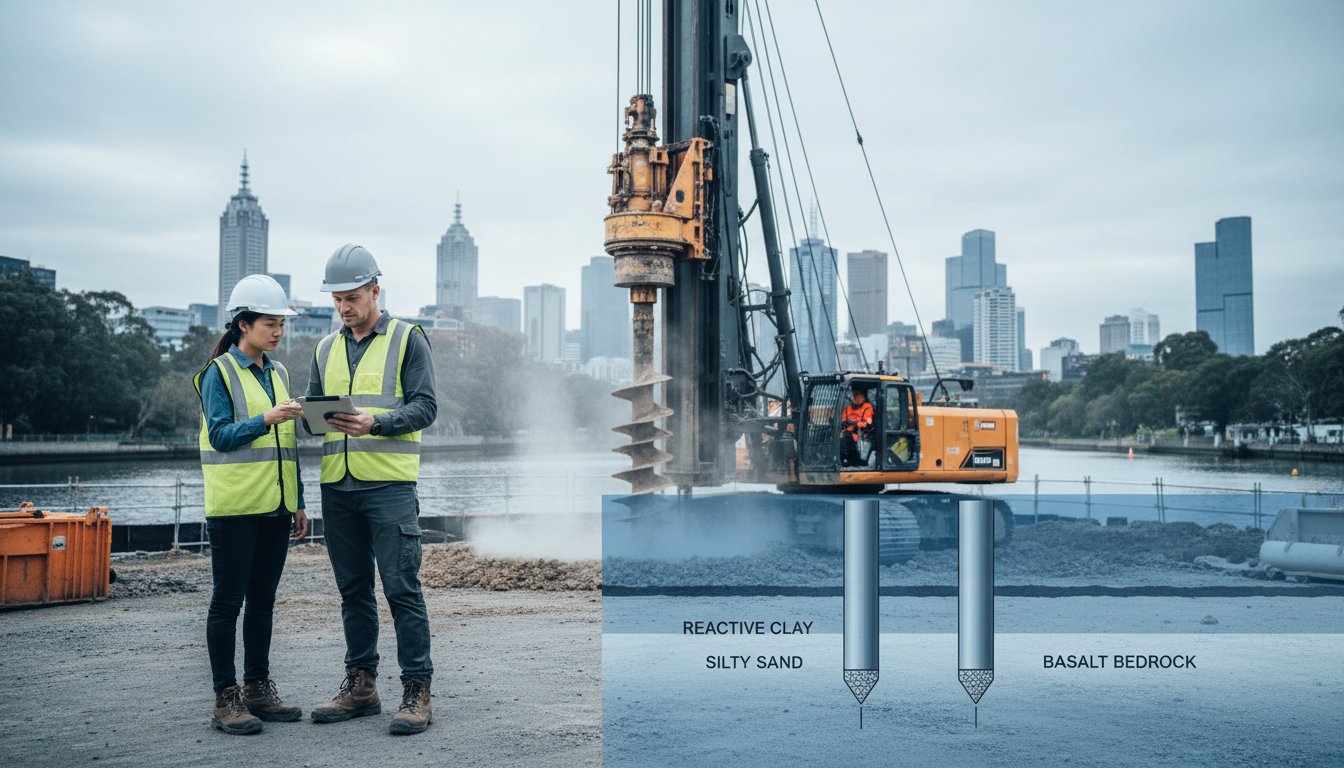
Concrete Piles in Melbourne: The Engineer’s Guide to Deep Foundations (2026)
More than 60% of foundation settlement issues in Melbourne’s CBD can be traced back to one critical miscalculation: underestimating the Yarra Delta's reactive clays. It’s a challenge every engineer and developer faces. The ground beneath our city isn't uniform; it’s a complex mix of hard basalt rock and unpredictable soil conditions that can compromise the structural integrity of any project if not managed with absolute precision. Failure isn't an option when your reputation is on the line.
This guide removes the guesswork. We're here to provide a clear, comprehensive framework for mastering the design and installation of concrete piles in Melbourne, moving you from geological uncertainty to certified structural security. We will break down the specific challenges of local ground conditions, detail the engineering design process compliant with Australian Piling Standard AS 2159-2009, and outline the pathway to a rock-solid, cost-effective deep foundation system that stands the test of time.
Key Takeaways
Learn to identify Melbourne’s specific geological challenges, ensuring your foundation design bypasses reactive clays to reach stable ground.
Distinguish between cast-in-situ and precast concrete piles to determine the most suitable solution for your site's load and access requirements.
Understand how to translate a Geotechnical Report into precise piling specifications, calculating for both skin friction and end-bearing capacity.
Discover how piles form the structural core of basement retention systems, transitioning from foundation support to earth retention.
Table of Contents What are Concrete Piles and Why Does Melbourne Require Them? Types of Concrete Piles: Cast-in-Situ vs. Precast Engineering Design and Soil Analysis for Piling Concrete Piles for Basement Retention Systems The Buildco Group Approach: Engineering-Led Piling
What are Concrete Piles and Why Does Melbourne Require Them?
Beneath Melbourne's vibrant surface lies a complex geological puzzle. For developers, builders, and homeowners, this means the ground can’t always be trusted to support a structure on its own. This is where concrete piles become a non-negotiable foundation for structural integrity. A pile is a deep foundation element, essentially a strong column of concrete, driven or drilled deep into the ground to provide stable support.
The primary function of these piles is to bypass weak or reactive upper soil layers, like Melbourne's notorious swelling clays, and transfer the building's load to a more competent stratum of soil or rock far below. From the high-rise towers shaping the CBD skyline since the mid-20th century to modern homes on sloping suburban blocks, piling has been the engineering solution that makes construction possible on our city's challenging terrain. A standard raft slab, while suitable for flat, stable ground, often fails when faced with the reactive soils, undocumented fill, or steep gradients common across Victoria, leading to costly structural defects down the line.
The Purpose of Deep Foundations
At its core, a deep foundation system serves critical functions that shallow footings cannot. It is an engineered solution designed to guarantee long-term stability by anchoring a structure to the earth with precision. The key objectives include:
Load Transfer: The system channels the entire structural load, including the building's weight and its contents, past unstable soil layers. It transfers these forces directly to solid bedrock or a dense soil stratum with proven load-bearing capacity, ensuring the building rests on solid ground.
Resisting Complex Forces: In projects involving high-rise towers or deep basements, piles are engineered to resist more than just downward gravity. They counteract lateral forces from wind and soil pressure, as well as uplift forces from groundwater, effectively locking the structure in place.
Preventing Differential Settlement: Many sites in Melbourne, particularly in former industrial areas like the Docklands, are built on "filled" land. This unconsolidated ground settles unevenly, causing cracks and structural failure. Piles provide uniform support across the entire foundation, eliminating this risk.
Melbourne’s Geological Challenges
A one-size-fits-all approach to foundations is destined for failure in Melbourne. A site's location dictates the specific challenges and, therefore, the required piling solution. Our geotechnical engineers consistently navigate three dominant geological profiles:
Western Suburbs: The vast plains west of Melbourne are defined by the Quaternary Basalt of the Newer Volcanics formation. This often presents a hard "floating rock" crust over highly reactive clays. Piling strategies must either socket securely into this basalt layer or drill through it to reach a more stable underlying material.
Northern Suburbs: In areas like Epping and across the northern growth corridor, the ground consists of heavily weathered Silurian Mudstone. Its consistency can change dramatically over short distances, requiring detailed geotechnical investigation to determine the precise depth needed to bypass the fractured, unstable zones.
Bayside Areas: Suburbs along Port Phillip Bay contend with high water tables and the sandy, less consolidated soils of the Brighton Group formation. This environment demands specific piling techniques, like Continuous Flight Auger (CFA) piling, to prevent the boreholes from collapsing during construction and to ensure the long-term durability of the piles.
Types of Concrete Piles: Cast-in-Situ vs. Precast
Choosing the right foundation is the most critical decision in any construction project. The structural integrity of your entire build rests upon it. In Melbourne, the choice between piling systems typically comes down to two primary methods: cast-in-situ bored piers and driven precast piles. This decision isn't based on preference; it's a calculated engineering choice dictated by geotechnical reports, site access, environmental regulations, and the specific load requirements of the structure.
Understanding the fundamental differences between these two types of concrete piles is essential for project stakeholders. One is manufactured on-site, perfectly tailored to the ground it occupies. The other arrives ready-made, offering speed and consistency for large-scale applications. Each has distinct advantages and limitations that make it suitable for different scenarios across Melbourne's diverse geological landscape.
Bored Piers (Cast-in-Situ)
Bored piers are constructed directly on site. The process is methodical: first, a powerful auger drills a cylindrical shaft through the soil and weathered rock to a predetermined depth, often until it reaches the stable Yarra Delta silts or underlying Silurian mudstone. A steel reinforcement cage is then lowered into the shaft, and high-strength concrete (typically 40-50 MPa) is poured, forming a solid, monolithic pile. This bespoke method ensures the pile is perfectly integrated with the site's unique ground conditions. It's why bored piers are the superior choice for Melbourne projects requiring deep rock-socketing for maximum end-bearing capacity. The precise calculation of this capacity is a complex geotechnical exercise, governed by principles detailed in guides like the U.S. Army Corps of Engineers' Design of Pile Foundations manual.
Crucially, the drilling process generates minimal vibration and significantly less noise than pile driving. This makes bored piers the only viable option for construction in Melbourne's dense residential areas or adjacent to sensitive structures, where percussive methods would pose an unacceptable risk of damage.
Precast and Driven Concrete Piles
Precast concrete piles are manufactured in a controlled factory environment, often using advanced techniques like centrifugal spinning or pre-stressing to achieve exceptional compressive strengths exceeding 80 MPa. These elements are then transported to the site and driven into the ground with a hydraulic or drop hammer. This method offers unparalleled speed and quality control, making it ideal for large-scale civil and industrial projects like bridge works, port facilities, and major infrastructure where hundreds of identical piles are required.
Their primary limitation, however, is performance in difficult ground. While effective in uniform clays or sands, a driven pile can be damaged or meet premature refusal when it encounters the hard basalt rock common in Melbourne's western suburbs. Unlike a bored pier, it cannot drill through these obstructions, restricting its application on sites with variable or shallow rock profiles. Selecting the correct piling method is fundamental to a project's long-term safety and budget. For a detailed assessment of your site's unique geotechnical challenges, our team provides expert foundation analysis to ensure a compliant and robust outcome.

Engineering Design and Soil Analysis for Piling
Successful piling is not a matter of guesswork; it's a precise engineering discipline. A foundation’s integrity rests entirely on a design that responds directly to the unique ground conditions of a site. Opting for a generic, "one-size-fits-all" design is the fastest route to unforeseen challenges, costly variations, and significant budget blowouts once machinery is on site. A bespoke engineering plan, grounded in thorough analysis, is the only way to guarantee structural performance and cost certainty.
The load-bearing capacity of a pile is determined through two primary mechanisms: end-bearing and skin friction. In Melbourne, where foundations often terminate in the stable Silurian mudstone or Newer Volcanics basalt, both are critical. End-bearing capacity is the force the pile can withstand from its base resting on solid rock. Skin friction is the resistance generated along the entire shaft of the pile as it grips the surrounding soil and rock. A robust design calculates the precise contribution of each to ensure the structure’s loads are safely transferred deep into the ground.
Understanding the Geotechnical Report
The Geotechnical Report is the single most important document for designing concrete piles. It provides the essential data our engineers use to specify the correct pile diameter, depth, and reinforcement. This report moves the project from assumption to fact, detailing exactly what lies beneath the surface. Key data points we analyse include:
Standard Penetration Test (SPT) Values: These 'N' values measure the density of the soil. An SPT 'N' value below 4 indicates very soft clays, whereas a value over 50 signifies refusal on rock, giving us a clear map of the subsurface layers.
Required Rock Socket Depth: The report identifies the depth of competent, load-bearing rock. The engineering design will then specify a "rock socket," which is the minimum length the pile must be drilled into this rock, often 500mm or more, to achieve the necessary end-bearing capacity.
Soil Reactivity Classification: Melbourne soils can be highly reactive. A classification of H1 (Highly Reactive) or E (Extremely Reactive) under AS 2870 means the ground swells and shrinks significantly with moisture changes. This dictates the amount of steel reinforcement needed to handle the resulting tensile forces.
Structural Certification Requirements
A piling design is incomplete without formal certification from a qualified structural engineer. This sign-off, often in the form of a Certificate of Compliance (Design), confirms that the proposed solution is safe, sound, and meets all regulatory requirements. The certification process verifies critical details, including the specified concrete strength (typically 32 MPa or 40 MPa for piling) and the exact placement of the steel reinforcement cage within the pile. Every calculation, from load capacity to material specification, must adhere to the stringent guidelines outlined in the Australian Standard for Piling (AS 2159-2009). AS2159:2009 stands as the non-negotiable benchmark for Australian piling safety, design, and installation.
Concrete Piles for Basement Retention Systems
In modern Melbourne construction, concrete piles perform a dual role. They are not just foundation elements transferring building loads to stable ground; they are the fundamental skeleton of a subterranean structure. For basement construction, particularly on tight inner-city sites, these piles form the perimeter retention wall before a single scoop of soil is excavated. This top-down approach provides immediate structural support to neighbouring properties and public land, ensuring safety and site stability from day one.
This process transforms a series of individual foundation points into a cohesive, powerful earth-retaining wall. Once the piles are installed along the boundary, they are structurally linked at the top with a reinforced concrete capping beam. As excavation proceeds downwards in stages, shotcrete is often applied between the piles, creating a smooth, impermeable final wall. This integrated system is a testament to meticulous engineering, managing immense lateral earth and water pressures while safeguarding adjacent assets.
Contiguous vs. Secant Pile Walls
Choosing the correct piling system is dictated by site-specific geotechnical analysis. For sites with stable, cohesive soils and a low water table, such as those found across Melbourne's eastern suburbs, a contiguous pile wall is often the most efficient solution. These walls consist of discrete piles installed with a small, designed gap of 100mm to 150mm between them, effectively retaining dry and stable ground.
Conversely, sites with non-cohesive soils or a high water table, common in areas like South Melbourne or near the Yarra River, demand a secant pile wall. This method involves installing interlocking primary (female) and secondary (male) piles. The secondary piles are bored to cut into the primary piles on either side, forming a continuous, watertight barrier that is essential for preventing water ingress and ground subsidence during and after excavation.
Rock Drilling and Retention
Melbourne's geology presents unique challenges. Drilling through the hard Newer Volcanics basalt, with compressive strengths exceeding 150 MPa in the city's western regions, requires specialised equipment. We utilise heavy-duty drilling rigs equipped with tungsten-carbide rock augers and core barrels to penetrate this formidable ground with precision. This isn't just about force; it's about control.
Verticality is non-negotiable. A retention pile's primary function is to act as a vertical cantilever beam. A deviation from plumb can compromise the structural integrity of the entire basement wall. Our teams work to a strict verticality tolerance, often 1 in 150, ensuring that each pile is perfectly aligned to form a structurally sound and straight wall. This meticulous attention to detail prevents future waterproofing issues and guarantees the long-term stability of the excavation.
A successful basement project begins with a robust and compliant retention strategy. Consult with our engineering team to design a bespoke piling solution for your project.
The Buildco Group Approach: Engineering-Led Piling
A building’s integrity begins below the ground. While many contractors view piling as a standalone task, we see it as the critical first step in a project’s lifecycle. That’s why we champion a Design & Construct (D&C) model for all our foundation work. This integrated approach removes ambiguity, streamlines communication, and places total accountability with a single, expert team. It’s about mitigating risk before a single hole is bored.
Our in-house engineering expertise allows us to develop bespoke foundation solutions tailored to Melbourne’s diverse geological conditions. We don’t just execute plans; we interrogate them, optimise them, and ensure they deliver maximum stability and value. This is our "Steady Hand" philosophy in action: a commitment to precision from the initial geotechnical analysis to the final concrete pour. Every decision is guided by a deep understanding of structural loads, soil mechanics, and the specific demands of your project, whether it's a multi-level commercial structure or a complex residential build.
Turnkey Foundation Solutions
We manage the complete foundation workflow under one roof. This seamless integration of services prevents the costly delays and disputes that often arise when separate subcontractors are involved. Our process covers:
Initial site assessment and rock drilling
Precision boring and reinforcement cage fabrication
Bulk excavation and spoil removal
Retaining wall construction, including shotcrete application
This single point of contact was pivotal for a recent project in Epping, where our team encountered challenging basalt rock formations. Because we controlled the entire piling and excavation sequence, we could adapt our drilling techniques on the fly, avoiding a multi-week delay and keeping the project firmly on schedule and budget.
Quality Assurance and Transparency
Trust is built on transparency. For every project, we provide meticulous documentation, including detailed pile logs that record bore depth, reinforcement details, and concrete test results. This verifiable data ensures every one of our concrete piles meets and exceeds the stringent requirements of Australian Standard AS 2159-2009. We combine the personal accountability of a family-owned business with the sophisticated tracking and reporting technology of a corporate-level firm.
It’s this blend of disciplined process and unwavering commitment that defines our work. We believe a strong foundation is the best investment you can make. Contact the Buildco Group Pty Ltd team for a certified piling quote today.
Building Melbourne's Future on a Foundation of Certainty
Navigating Melbourne's challenging geotechnical landscape requires more than just materials; it demands precision engineering. As we've detailed, the success of a structure hinges on correctly specifying deep foundations, from detailed soil analysis to the selection between cast-in-situ and precast options. It’s a foundational decision where there is simply no room for error.
The Buildco Group provides that essential engineering certainty. Our in-house Civil Engineering Team designs every project with meticulous attention to detail, ensuring all concrete piles are fully compliant with AS2159. As proven specialists in Melbourne rock drilling, we have the technical expertise and equipment to manage even the most complex site conditions, delivering a truly end-to-end solution.
When you're ready to secure your project's structural integrity from the ground up, partner with the experts. Get a Professional Piling and Foundation Quote today and let's build a lasting legacy together.
Frequently Asked Questions About Concrete Piles
How much do concrete piles cost per metre in Melbourne?
The cost of concrete piles in Melbourne typically ranges from A$180 to A$350 per lineal metre. This price is influenced by the pile diameter, the complexity of steel reinforcement, and site accessibility. Projects with tight access or difficult ground conditions will fall at the higher end of this range. We provide a detailed, fixed-price quote after a thorough site assessment and review of your engineering plans to ensure complete transparency from the start.
Do I need a geotechnical report before getting a piling quote?
Yes, a geotechnical report is essential for an accurate and reliable piling quote. This report provides critical data on soil composition, groundwater levels, and the depth of stable, load-bearing ground. Without it, any quote is merely an estimate. The report allows engineers to design the most efficient and safe foundation, ensuring the structural integrity of your project and preventing costly variations down the line. It's a non-negotiable step in our quality assurance process.
What is the difference between a bored pier and a concrete pile?
The terms are often used interchangeably, but a bored pier is a specific type of cast-in-situ concrete pile. "Concrete pile" is the general term for a deep foundation element made of concrete. A "bored pier" specifically refers to the construction method: a hole is bored into the ground with an auger, a steel reinforcement cage is placed inside, and the hole is then filled with concrete. It's the most common type used for residential and commercial projects in Melbourne.
How deep do concrete piles usually need to go in Melbourne?
Pile depth in Melbourne varies significantly due to the city's diverse geology. In the western suburbs with reactive basalt clays, depths might be 3 to 6 metres. Closer to the Yarra River on Coode Island Silt, piles may need to extend over 20 metres to reach stable ground. The exact depth required for your site is determined by the engineering design, which is based on the findings of a site-specific geotechnical investigation to guarantee foundation stability.
Can concrete piles be installed close to my neighbour’s fence?
Yes, piles can be installed very close to boundary fences using specialised limited-access piling rigs. These machines are designed for compact spaces and can often operate within 500mm of an existing structure or fence line. A pre-construction survey and careful planning are critical to protect the neighbouring property. Our team conducts a thorough site assessment to determine the right equipment and methodology for your specific boundary conditions, ensuring a safe and compliant installation.
How long does the concrete take to cure before building can start?
Concrete generally reaches approximately 70% of its specified compressive strength within 7 days. At this point, it's often strong enough for subsequent construction stages, like slab preparation, to begin. The concrete will continue to cure and gain strength over time, reaching its full 28-day design strength as per Australian standards. We can also utilise high-early-strength concrete mixes if your project schedule requires an accelerated timeline, without compromising structural integrity.
What happens if the drill hits hard rock unexpectedly?
If our drill encounters rock that wasn't indicated on the geotechnical report, we switch to specialised drilling attachments. Rock augers and core barrels are designed to penetrate and break through basalt or siltstone, which is common across Melbourne. This can adjust the project's timeline and cost, and our project manager will communicate with you immediately to discuss the options. This transparent approach ensures there are no surprises and we can proceed with the most effective solution.
Are concrete piles better than screw piles for Melbourne soil?
The best solution depends entirely on the project's engineering requirements and ground conditions. Concrete piles offer exceptionally high load-bearing capacity and are ideal for the highly reactive clay soils found in many Melbourne suburbs. Screw piles can be installed faster with less site disturbance, making them suitable for sites with access challenges or specific soil profiles. We assess your project's unique needs to recommend the foundation system that delivers the best performance and long-term value.
Comments