Your choice of piling contractor will make or break your entire Melbourne project before the first beam is ever raised. It’s a decision fraught with risk, where a single miscalculation can lead to budget blowouts and critical project delays. You're not just worried about hitting unexpected basalt rock formations in the western suburbs; you're rightfully concerned about achieving long-term structural integrity, the logistical nightmare of coordinating separate excavation and piling teams, and the non-negotiable requirement of AS 2159:2009 compliance.
This 2026 engineering guide is your blueprint for eliminating that uncertainty. We deliver the critical insights needed to master Melbourne’s unique geotechnical challenges, from Coode Island Silt to Brighton Group sands. You'll learn how to vet and select the elite piling contractors Melbourne developers trust, securing a turnkey solution that guarantees your project is built on a foundation of absolute certainty. We'll deconstruct everything from screw piling and CFA techniques to interpreting soil reports and managing earth retention systems for a seamless, compliant build.
Key Takeaways
Learn to interpret a geotechnical report to select the correct piling method for Melbourne’s highly variable ground conditions.
Understand the critical engineering difference between end-bearing and skin friction piles to ensure long-term structural integrity.
Discover how a Design and Construct (D&C) approach prevents costly over-engineering in deep foundation and retention systems.
Use our compliance checklist to properly vet piling contractors melbourne based on their licensing, insurance, and fleet capability.
Table of Contents Navigating Melbourne’s Complex Geotechnical Landscape for Piling Essential Piling Methods for Melbourne Construction in 2026 The Design and Construct (D&C) Advantage in Earth Retention Selecting a Piling Contractor: Compliance and Capability Checklist Engineering the Future: Why Buildco Group Leads Melbourne Piling
Navigating Melbourne’s Complex Geotechnical Landscape for Piling
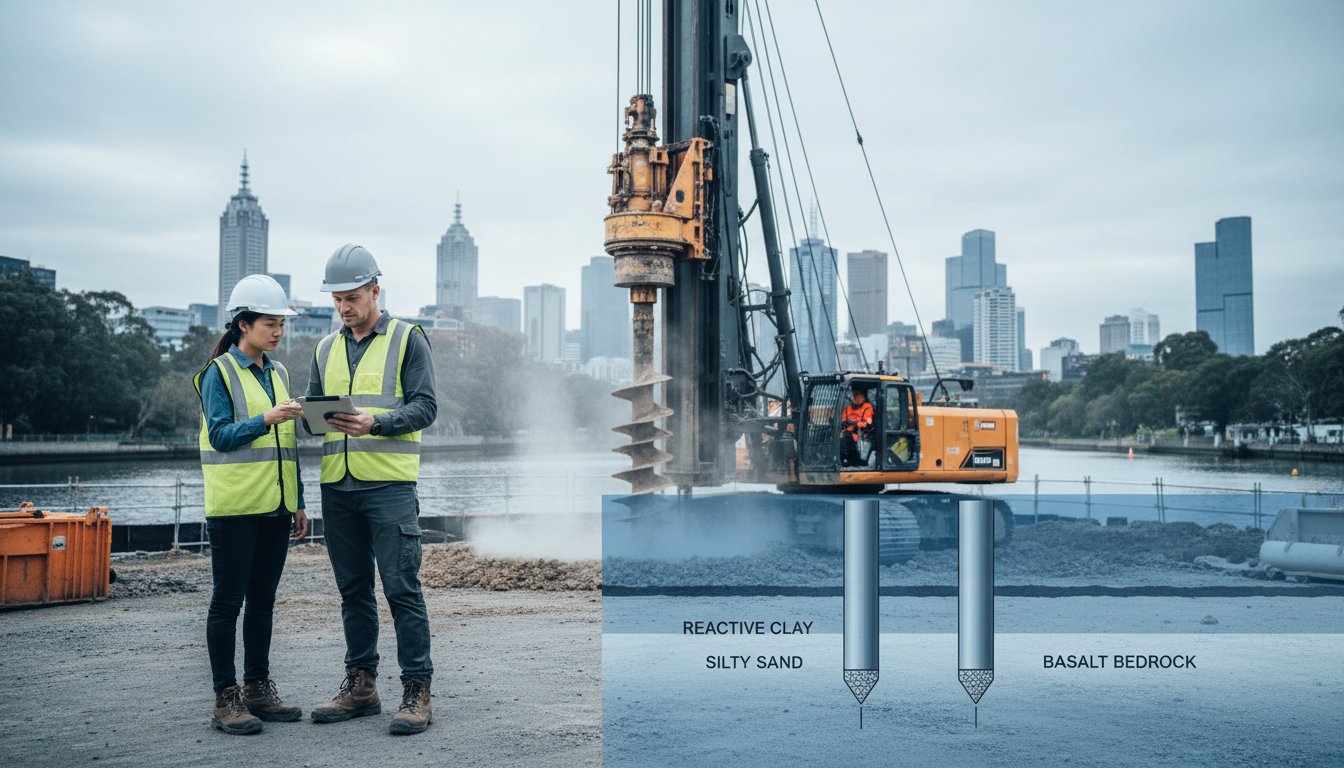
Melbourne’s geology presents one of the most diverse and challenging subterranean environments in Australia. Unlike the relatively uniform sandstone of Sydney or the sandy plains of Perth, a Melbourne construction site can feature a complex mix of reactive clays, soft silts, and extremely hard basalt rock, sometimes all within a few metres. Understanding this variability is the first step in ensuring the structural integrity of your project. An expertly designed piling system is not just a recommendation; it's a necessity for long-term stability.
The foundation of any successful piling project is the Geotechnical Report. This document, prepared by a qualified engineer, provides a detailed analysis of the ground conditions at your specific site. It acts as a blueprint, informing your chosen piling contractors in Melbourne about the precise depth, diameter, and type of pile required to support the proposed structure. A pile is essentially a deep foundation structural element, and without this data, any piling work is pure guesswork, risking budget blowouts, project delays, and catastrophic structural failure.
In low-lying areas like Southbank, Docklands, and Port Melbourne, the high water table introduces another layer of complexity. Saturated, unstable soils can easily collapse during drilling. This requires specialised techniques like Continuous Flight Auger (CFA) piling, where concrete is pumped as the auger is withdrawn to ensure the pile's integrity. Ignoring the water table can lead to compromised foundations and significant remedial costs down the line.
Basalt, Silt, and Mudstone: What’s Under Your Site?
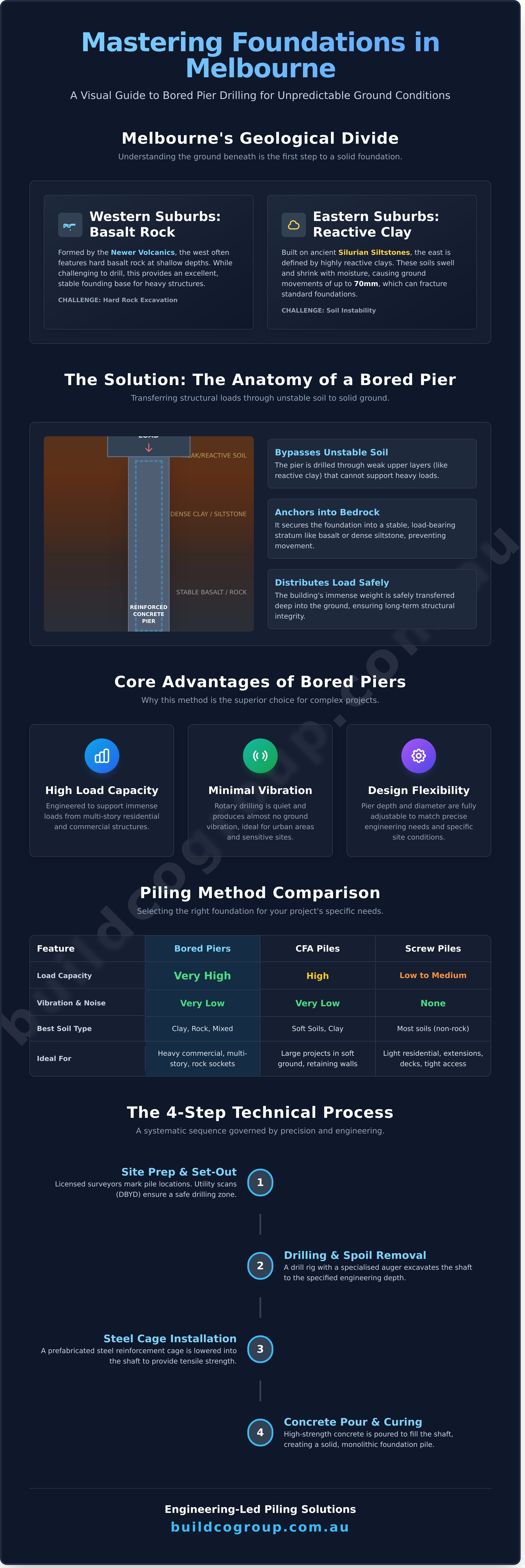
Melbourne's geology is a story of three dominant materials. The city's western suburbs sit atop the "Newer Volcanics," vast basalt flows from ancient volcanoes. This rock is exceptionally hard and can cause "geotechnical refusal," where drilling progress stops. In the CBD and eastern suburbs, you'll often encounter Silurian Mudstone, a sedimentary rock over 400 million years old. While stable, finding a suitable founding depth in this mudstone can require deep, powerful drilling. Finally, the infamous Coode Island Silt around the Yarra River is a soft, compressible marine clay that offers very poor load-bearing capacity, making deep friction piles the only viable solution.
From Residential to Civil: Scaling the Solution
The piling solution for a residential extension is vastly different from a commercial basement retention system. A standard home might require a dozen bored piers, each around 450mm in diameter, to a depth of a few metres. A multi-level commercial basement, however, demands a contiguous or secant pile wall involving hundreds of interlocking piles, extensive anchoring, and precise engineering to retain tonnes of earth. Site access is also a critical factor. Executing piling works on tight-access inner-city blocks in suburbs like Fitzroy or Richmond requires specialised, compact rigs that can navigate narrow laneways without compromising on power. Expert piling contractors in Melbourne possess a diverse fleet of machinery to tackle any access constraint.
Geotechnical refusal occurs when a piling drill encounters rock or a dense soil layer that it cannot practically penetrate with its specified equipment and energy.
Essential Piling Methods for Melbourne Construction in 2026
Selecting the right deep foundation technique is the most critical decision for a structure's long-term stability in Victoria. Melbourne’s geology is notoriously diverse, from the soft Coode Island Silt to the hard-wearing Newer Volcanics basalt. A pile's performance depends entirely on how it transfers the building's load to the ground. This happens in two primary ways: through end-bearing, where the pile rests directly on a solid rock layer, or via skin friction, where the load is supported by the friction between the pile's surface and the surrounding soil.
The ground conditions dictate not only the piling method but also the need for support during drilling. Temporary or permanent steel casing is often required in unstable soils, such as sand or water-charged clays, to prevent the pile shaft from collapsing before concrete is poured. As we look toward 2026, the industry continues to shift, with a clear trend toward high-torque drilling rigs that can penetrate dense rock formations faster and more efficiently than ever before, reducing project timelines and costs.
Bored Piers and Concrete Piles
For projects founded on Melbourne's stable clays or weathered rock, bored piers are the gold standard. This method involves drilling a shaft to the specified depth, installing a steel reinforcement cage, and pouring concrete to form a solid, high-capacity pile. Its cost-efficiency in predictable ground makes it a preferred solution for commercial and residential developments across the city. The entire process is a seamless sequence that delivers exceptional load-bearing capacity, making it a reliable choice for any structure built on solid earth.
CFA Piling (Continuous Flight Auger)
Continuous Flight Auger (CFA) piling is the go-to solution for challenging sites with high water tables or unstable, sandy soils. Unlike traditional bored piers where the hole is open, a CFA rig drills with a hollow-stem auger that continuously supports the surrounding ground. Concrete is then pumped through the auger's stem as it's withdrawn, eliminating the risk of collapse. This vibration-free installation is essential for inner-city projects, protecting adjacent heritage structures in suburbs like Fitzroy and East Melbourne from structural damage.
Screw Piles and Micro-Piling
Screw piles offer unmatched installation speed for lightweight structures or remedial underpinning. These galvanised steel piles are screwed into the ground, making them ideal for residential extensions, decking, or solar farm footings. However, their primary limitation is encountering Melbourne’s dense basalt rock, where they often meet refusal. For sites with restricted access, such as basement retrofits or foundation repairs under existing buildings, micro-piles provide the perfect answer. These smaller-diameter piles can be installed with compact rigs in low-headroom environments.
Ultimately, the right method depends entirely on a detailed geotechnical investigation. All these techniques involve significant excavation, and professional piling contractors Melbourne must operate with absolute precision and safety. Every procedure must align with the national code of practice for excavation work to ensure the safety of the team and the integrity of the project. Understanding how these methods perform in Melbourne's unique ground conditions is the foundation of a successful build, and our team can help you assess your project's specific geotechnical needs to ensure a secure result.

The Design and Construct (D&C) Advantage in Earth Retention
A successful basement project hinges on more than just drilling holes. It demands a seamless fusion of engineering design and practical construction. The traditional approach, where an independent engineer designs the system and a separate contractor builds it, often creates a costly disconnect. Without direct feedback from the team on the ground, designs can become "over-engineered" with excessive pile diameters or conservative spacing, leading to wasted materials and budget blowouts. This is a common pitfall we see across Melbourne.
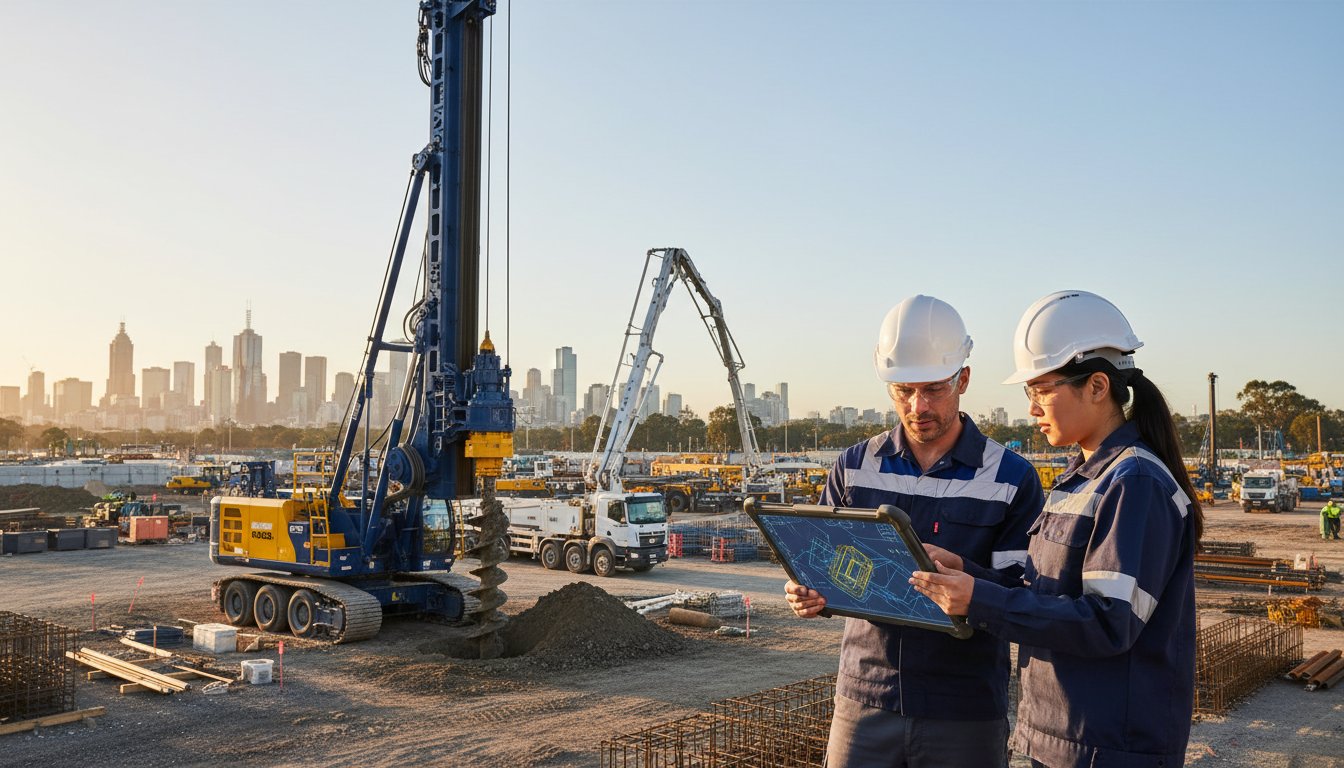
The Design and Construct (D&C) model eliminates this gap. By integrating our civil engineers directly into the project team, we deliver turnkey basement solutions built on efficiency and real-world data. Our engineers don't just work from a geotechnical report; they work with our piling crews. This collaborative process allows for dynamic adjustments, optimizing pile design based on the actual ground conditions encountered on-site. It’s a smarter way to build, ensuring every dollar is invested in structural integrity, not unnecessary materials.
This integrated approach is where the best piling contractors melbourne deliver true value. They take full accountability for the entire earth retention scope, from the initial design and piling to the final shotcrete finish.
Case Study: Averting Unforeseen Rock Costs in Epping
On a recent multi-level basement project in Epping, the initial third-party design was based on a conservative geotechnical report that predicted deep soil profiles. During the first day of drilling, our team hit shallow, hard basalt rock far earlier than anticipated. In a traditional contract, this would have triggered a stop-work notice, weeks of redesign delays, and a variation claim for rock excavation likely exceeding $A85,000. With our D&C model, our in-house engineer was able to re-evaluate the design on-site that same day. They optimised the pile design to found on the rock, reducing pile depths and saving the client the full cost of the variation and three weeks of project delays.
Basement Retention Systems: Beyond the Piles
A robust basement requires an integrated system. We design and install the most appropriate solution for your site's specific geology, often choosing between soldier pile walls for cost-effective retention or contiguous pile walls where water ingress is a concern. These piles are unified by a capping beam, a critical reinforced concrete element that distributes loads and ensures the wall acts as a single structural unit. For deep excavations, we use high-tensile rock anchors and temporary shoring, a process demanding strict adherence to the WorkSafe Victoria piling safety guide to guarantee total site stability.
Shotcrete and Structural Support
Once piles are in place, shotcrete (sprayed concrete) provides rapid and durable wall support. It’s applied between the piles as excavation progresses, securing the site and forming the final basement wall. Beyond its structural function, we deliver high-quality finishes suitable for exposed walls in car parks and premium spaces. Our integrated design process directly informs construction methodology, allowing for precise material calculations that reduce structural steel and concrete waste by up to 15% compared to conventionally engineered projects.
Selecting a Piling Contractor: Compliance and Capability Checklist
Choosing a piling partner is one of the most critical decisions for your project's structural integrity and long-term success. Beyond a competitive price, your selection process must be a rigorous assessment of compliance, capability, and proven local performance. A mistake here isn't just costly; it can compromise the entire build and lead to significant delays in achieving your occupancy permit.
The foundation of your due diligence starts with the non-negotiables. Any professional contractor must provide current certificates for:
Public Liability Insurance: A minimum of A$20 million in coverage is standard for commercial and complex residential projects.
WorkSafe Victoria Registration: Verifies the company operates legally and adheres to state-specific occupational health and safety laws.
Operator Licensing: All rig operators must hold the appropriate High-Risk Work Licence (HRWL) for the machinery they use.
Next, scrutinise their fleet against your geotechnical report. Melbourne's ground conditions are notoriously variable, from the soft Coode Island Silt near the Yarra to the hard Silurian mudstone and basalt in the northern suburbs. A contractor with only small-bore rigs will be unable to achieve the required depths or capacities in challenging rock. This directly impacts quoting transparency. Some quotes may appear low because they exclude rock drilling, later billed at an exorbitant hourly rate. A trustworthy quote from experienced piling contractors melbourne will always account for anticipated rock based on the geotechnical data, providing a clear, fixed price or a transparent schedule of rates for unforeseen conditions.
Finally, a proven portfolio of Melbourne-based projects is your best indicator of future success. It demonstrates a deep understanding of local council regulations, traffic management in tight inner-city sites, and experience with the city's unique geological challenges.
Australian Standards and Certification
Your project’s compliance hinges on adherence to AS 2159:2009 (Piling - Design and Installation). This standard governs every aspect of the work. A key requirement is pile testing to verify load-bearing capacity. This can involve Dynamic Load Testing (PDA) for efficiency or Static Load Testing for definitive results on critical piles. Upon completion, your contractor’s work must be certified by a structural engineer, providing the essential Certificate of Compliance required by your building surveyor for your Occupancy Permit.
Safety and Environmental Stewardship
Operating heavy machinery in dense residential areas demands meticulous planning. Reputable contractors have clear strategies for managing noise and vibration, often using real-time monitoring to stay within EPA Victoria guidelines and maintain good community relations. Equally important is spoil management. Excavated material must be correctly classified and disposed of legally and ethically, a process that can add significant cost if not planned for. The choice of drilling tools is essential for minimising disruption. For more detail on this, see our Melbourne Rock Drilling Guide.
A contractor’s commitment to these standards isn’t just about ticking boxes; it’s a direct reflection of their professionalism and respect for your investment. To ensure your project is built on a foundation of quality and compliance, discuss your site-specific requirements with the Buildco team today.
Engineering the Future: Why Buildco Group Leads Melbourne Piling
Choosing a piling contractor is one of the most critical decisions in any construction project. The foundation dictates the integrity, longevity, and ultimate success of the structure. At Buildco Group, we don't just drill holes; we engineer foundational certainty. We combine the personal accountability of a family-owned business with the technical discipline of a dedicated civil engineering firm, creating a service that is both reliable and rigorously precise.
Our team thrives on complexity. Melbourne’s geology, from the reactive clays in the northern suburbs to the dense basalt rock formations in the west, presents unique challenges that demand more than standard solutions. We take a proactive approach, meticulously analysing geotechnical reports to anticipate and mitigate issues before they impact your timeline or budget. This means selecting the right drilling rigs, augers, and techniques from day one, ensuring efficient progress even in the most unforgiving ground conditions. It’s this foresight that sets us apart from other piling contractors in Melbourne.
We deliver true turnkey accountability. Our integrated service model covers every critical stage of the substructure, providing a single point of contact and absolute responsibility for the outcome. This seamless process includes:
Initial Site Assessment: A thorough review of architectural and engineering plans.
Precision Piling: Expert execution of bored piers, screw piles, or CFA piling tailored to the site.
Detailed Excavation: Preparing the site for the next structural phase.
Steel Fixing and Formwork: Building the structural cage with meticulous attention to detail.
Concrete Pouring: Ensuring a high-quality pour for maximum strength.
Capping Beam Construction: Completing the foundation, ready for the builder to commence framing.
By managing this entire workflow, we eliminate the coordination gaps and scheduling conflicts that often arise between separate contractors. For our builder partners, this means a de-risked project, streamlined communication, and a fully certified foundation delivered on time and within budget.
Our In-House Engineering Expertise
Technical leadership on-site is non-negotiable. Our in-house civil engineers don’t just design the piling solution; they oversee its execution. This direct management model ensures that any unforeseen site challenges are addressed immediately with expert authority, reducing project friction and costly delays. We create bespoke designs tailored to your specific site survey, guaranteeing a foundation that is optimised for performance and cost-effectiveness, not a one-size-fits-all compromise.
Start Your Foundation with Buildco
Your project deserves a foundation built on integrity. The process begins with a detailed consultation where we review your architectural plans and geotechnical data to provide a firm, transparent quote. Our commitment to a "Standard of Excellence" is unwavering, applied consistently to every project we undertake across every Melbourne suburb. Secure the structural integrity of your build from the ground up. Request a comprehensive D&C proposal for your Melbourne project today.
Secure Your 2026 Foundation with Engineering Certainty
Melbourne's future skyline depends entirely on the foundations laid today. Successfully navigating the city’s variable geotechnical conditions in 2026 demands more than just equipment; it requires advanced piling techniques and a streamlined Design and Construct (D&C) approach to mitigate risk. Choosing the right partner isn't just a vendor selection, it's the most critical structural decision you will make.
The most capable piling contractors melbourne has to offer are those who embed engineering intelligence into every phase of the project. At Buildco Group, this is our foundational principle. Founded by Civil Engineers with over 20 years of local experience, we deliver a true in-house D&C solution, from initial design to final sign-off. Our comprehensive fleet, equipped for high-torque rock drilling, ensures we have the capability to match our engineering expertise on any site.
Don't leave your project's core integrity to chance. Partner with Melbourne’s engineering-led piling experts at Buildco Group and build with absolute confidence. Let's engineer a stronger future, together.
Frequently Asked Questions
How much do piling contractors in Melbourne typically charge?
Piling costs in Melbourne typically range from A$250 to A$450 per lineal metre for bored piers and A$400 to A$700 per screw pile, depending on diameter and depth. The final price is influenced by soil conditions, site access, and the total number of piles required. Reputable piling contractors Melbourne will provide a detailed quote based on your project's engineering plans, ensuring complete transparency on all costs, including potential charges for rock drilling.
What is the difference between bored piers and screw piles?
The primary difference lies in their installation. Bored piers are created by drilling a hole with an auger, inserting a steel reinforcement cage, and filling it with concrete. Screw piles are steel shafts with a helix that are screwed directly into the ground. Bored piers are often specified for bearing on rock and handling very high compression loads, while screw piles are excellent for speed and sites with reactive soils, as they cause minimal ground disturbance during installation.
Do I need a building permit for piling work in Victoria?
Yes, you will almost certainly need a building permit for piling work in Victoria. Piling is a critical structural element, and its design and installation fall under the scope of the Building Act 1993. The piling plans, certified by a structural engineer, must be submitted to your appointed building surveyor as part of your overall application. This ensures all work complies with the National Construction Code and local council requirements for safety and structural integrity.
How long does a typical piling installation take for a residential basement?
A typical piling installation for a standard residential basement in Melbourne takes between 3 to 7 working days. This timeframe covers the rig setup, drilling or screwing the piles to the specified depth, and placing reinforcement. The schedule can be affected by the total number of piles (often 30 to 50), difficult ground conditions, or restricted site access. A clear project plan will outline these key milestones from the start.
What happens if the piling rig hits unexpected rock?
If the piling rig hits rock, the standard procedure is to switch to a specialised rock-drilling auger or core barrel. Most professional contracts account for this with a provisional sum or a set rate for rock excavation, typically charged per lineal metre. A thorough geotechnical report conducted before work begins helps identify rock layers at specific depths, allowing us to plan for this and minimise costly delays. We always prioritise transparent communication if site conditions differ from the initial report.
Is piling necessary for all double-storey homes in Melbourne?
No, piling isn't necessary for all double-storey homes. The requirement is dictated entirely by the site's soil classification from a geotechnical report. Many Melbourne suburbs have highly reactive clay soils (Class H1, H2, or E), which swell and shrink with moisture changes. For these sites, piling is essential to transfer the building's load to more stable ground, preventing significant foundation cracking and future structural damage.
Can piling be done on a site with limited or narrow access?
Yes, piling can be performed on sites with limited access. We utilise specialised tight-access piling rigs, some of which are less than 1 metre wide, allowing them to pass through a standard side gate or narrow laneway. These machines, while compact, are powerful enough to install piles to significant depths for residential and small commercial projects. This capability ensures that challenging site logistics don't compromise the structural integrity of your foundation.
What is a capping beam, and is it always required for basement retention?
A capping beam is a reinforced concrete beam constructed along the top of a line of piles to connect them. For basement retention walls, such as a contiguous or secant pile wall, a capping beam is almost always required. Its critical function is to tie the individual piles together, distributing the lateral soil loads evenly across the entire wall system. This creates a unified, rigid structure that prevents independent pile movement and ensures long-term stability.